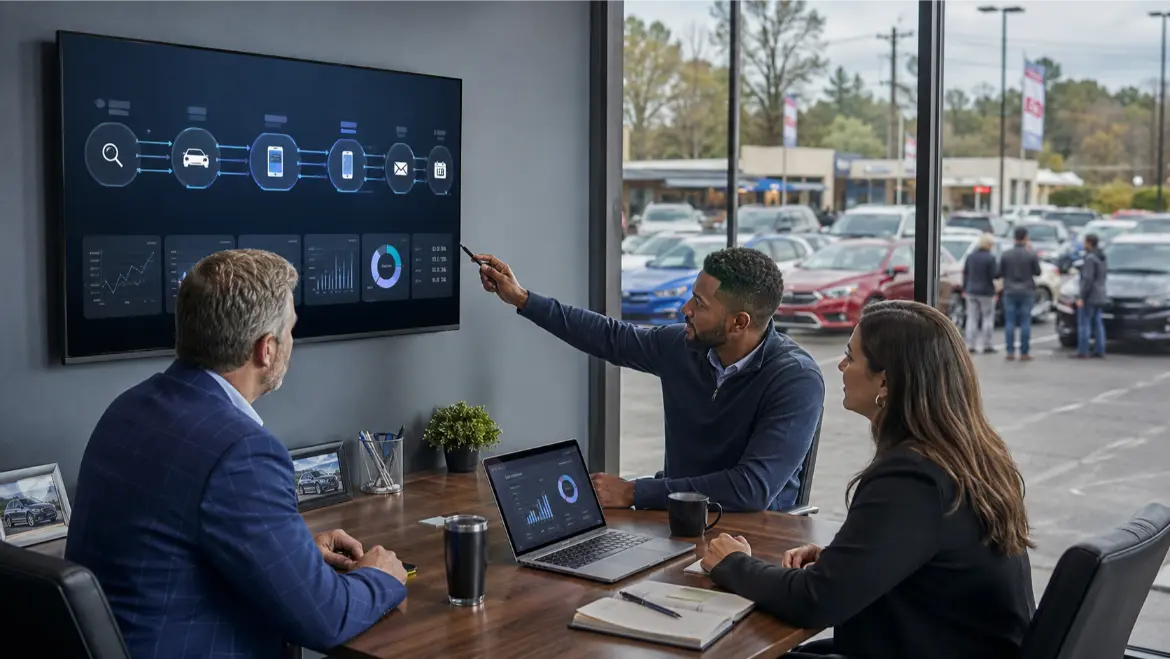
Organic leads for car dealers do not come from rankings alone. They come when a dealership website attracts a relevant local shopper, answers the reason for the search, presents trustworthy inventory and dealership information, and makes the next action obvious. A page can rank and still fail if the shopper cannot quickly find a vehicle, call or text the store, ask about availability, start a finance inquiry, or schedule a visit.
That distinction matters when paid advertising becomes more expensive. Organic search can build a second source of opportunity, but only when the website is designed as a connected system. Local SEO brings the right shopper to the site; inventory and content create relevance; trust signals reduce hesitation; calls to action convert interest; and tracking shows which pages create real dealership conversations.
Organic Traffic and Organic Leads Are Different Metrics
Organic traffic counts visits from unpaid search results. Organic leads count meaningful actions that began with that traffic, such as phone calls, texts, vehicle inquiries, appointment requests, trade-in submissions, or credit-related forms. A dealer can increase traffic without increasing leads if the visitors land on weak pages or cannot see a relevant next step.
Start with a simple question: what should a shopper do after arriving from search? The answer may differ by page. A city page should help a nearby shopper understand the dealership and browse inventory. A VDP should support questions about a specific vehicle. A financing article should lead to a clear application or consultation path. Organic lead generation improves when the action matches the visitor’s intent.
Map the Searches That Matter to the Dealership
Dealer websites serve several types of organic intent. Treating every search as a variation of “used cars near me” leaves important opportunities uncovered.
- Local dealership intent: used car dealer, BHPH dealer, or auto financing in a specific city or nearby market.
- Inventory intent: a particular make, model, body style, price range, mileage range, or vehicle feature.
- Financing intent: down payment, credit situation, required documents, payment process, or pre-qualification questions.
- Trust intent: reviews, warranties, trade-ins, dealership history, service support, hours, directions, and buyer policies.
- Decision intent: availability, test drive, appointment, trade-in value, application, phone call, or text conversation.
This map helps the dealer decide which pages deserve attention. Search volume alone is not the only criterion. A lower-volume query can be valuable when it comes from a nearby shopper who is ready to ask about a vehicle or begin the buying process.
Build a Strong Local SEO Foundation
Independent dealers depend heavily on nearby shoppers. The website and Google Business Profile should communicate consistent information about the dealership name, address, phone number, hours, primary category, inventory, and service area. Google’s local-ranking guidance emphasizes complete and accurate business information because it helps customers understand what the business does, where it is, and when they can visit.
The website should reinforce those local facts with a clear contact page, embedded directions, nearby markets served, dealership-specific content, and consistent phone routing. Avoid creating dozens of thin city pages that merely swap place names. Each useful location page should explain why the store is relevant to shoppers in that area, what inventory or financing options they can explore, and how to take the next step.
Use the Homepage as a Routing Page, Not a Keyword Container
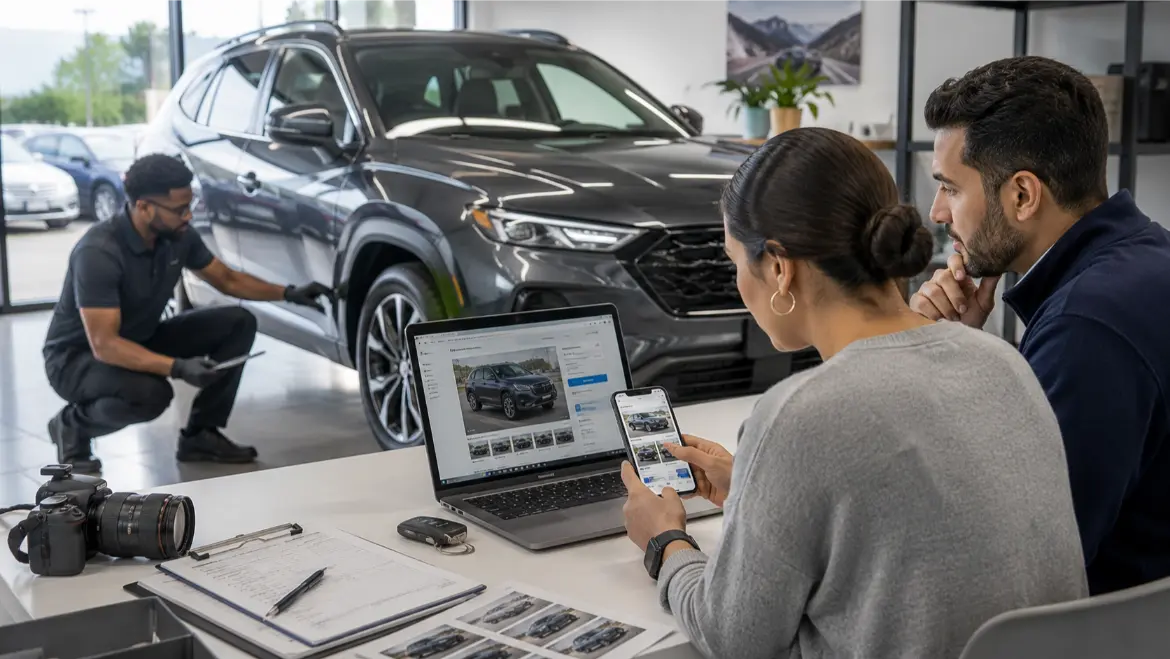
The homepage should quickly explain who the dealership serves, what it sells, where it operates, and which actions matter most. It should route visitors toward inventory, financing, trade-ins, directions, and contact options instead of forcing every possible keyword into one block of copy.
A good homepage creates several short paths: browse current inventory, start a finance conversation, ask about a trade-in, call or text the store, and learn why the dealership is credible. The goal is not to make the homepage answer every question; it is to help the right shopper reach the right page with minimal friction.
Make Inventory Pages Discoverable and Useful
Inventory category pages can attract shoppers searching by vehicle type, make, model, price, or financing need. These pages should contain real, current inventory and enough useful context to help both shoppers and search engines understand what is available. Empty pages, expired filters, duplicate URLs, and indexable combinations with no meaningful inventory can dilute the experience.
Use clear page titles, readable headings, stable URLs, useful filters, and internal links to relevant vehicles. Keep availability and price information current. When inventory changes, manage sold-vehicle pages consistently rather than allowing broken URLs or stale availability messages to accumulate.
Google has published vehicle-listing structured data guidance for dealerships. Markup can help Google understand vehicle information, but it must match the visible page and follow Google’s policies. Correct markup does not guarantee a special search appearance, so structured data should support an already accurate VDP rather than substitute for one.
Treat Every Vehicle Detail Page as a Landing Page
A vehicle detail page often receives a high-intent visitor. The shopper may have searched for a specific model or arrived from an inventory result. The VDP must therefore do more than display a feed.
- Use a descriptive title that includes the year, make, model, and dealership market where appropriate.
- Display accurate price, mileage, condition, key features, photographs, and availability information.
- Write a useful description that explains the vehicle rather than repeating generic manufacturer language.
- Place calls to action near the information shoppers use to decide: availability, financing, trade-in, appointment, call, and text.
- Make forms short enough to use on a phone while collecting enough information for meaningful follow-up.
- Link to related inventory so shoppers have a next step when the exact vehicle is not right.
- Handle sold vehicles and replaced inventory deliberately to avoid dead ends and misleading pages.
Turbo Dealer Websites describes VDPs, inventory browsing, Smart Forms, calls, and CRM-ready delivery as parts of one lead-focused framework. Dealers reviewing their current platform can compare that approach with the Turbo Dealer website framework.
Publish Content That Answers Real Buyer Questions
Organic dealership content should answer questions the sales and finance teams hear every week. Useful topics include required documents, down payment factors, trade-in steps, warranty coverage, vehicle availability, credit-application expectations, local buying considerations, and what happens after a form is submitted.
Google recommends people-first content that leaves readers with a satisfying answer rather than content created only to attract search traffic. For dealers, that means being specific about the store’s actual process. Generic articles that could belong to any dealership may attract impressions but do little to build trust or prepare the visitor to contact the store.
A strong content program should link educational pages to relevant inventory, financing pages, FAQs, and contact options. Dealers can review the Turbo Dealer blog and dealer website insights for examples of search, inventory, and buyer-question topics.
Align the Call to Action With the Page
A generic “Contact Us” button is not enough for every visitor. Calls to action should reflect what the shopper is trying to accomplish.
- VDP: Check availability, call about this vehicle, text the dealership, schedule a test drive, or start a financing request.
- Inventory category page: View details, compare vehicles, save a vehicle, or ask for help finding a match.
- Financing page: Start an application, request pre-qualification information, or ask what documents are needed.
- Trade-in page: Submit vehicle details or request a trade-in conversation.
- Location page: Get directions, call the store, view inventory, or confirm hours.
- Educational article: Continue to the relevant inventory, FAQ, financing, or lead form.
CTA alignment also improves lead quality. When the form or phone prompt matches the page, the sales team receives clearer context about what the shopper saw and what they want.
Add Trust Signals Before Asking for the Lead
Many shoppers hesitate before contacting an independent dealer because they still have unresolved questions. The website should reduce that uncertainty with accurate hours, directions, dealership history, real inventory photos, review access, accepted documents, trade-in information, warranty or service-contract details, financing explanations, and bilingual support when available.
These details are not decorative. They help a shopper decide whether the store is relevant and credible enough to call, apply, or visit. The Turbo Dealer onboarding process asks dealers for operational information such as surrounding markets, payment options, required documents, trade-ins, warranties, CRM routing, and Spanish-language support because those facts shape both content and lead flow.
Protect the Technical Foundation
Search engines must be able to discover, crawl, render, and understand dealership pages. Shoppers must be able to use them quickly on a phone. Technical priorities include secure hosting, mobile usability, fast page delivery, clean navigation, accurate canonical signals, useful sitemaps, functioning forms, and inventory feeds that do not create large numbers of duplicate or empty pages.
Review the site in Google Search Console and test representative pages rather than assuming the entire inventory behaves the same. Check the homepage, inventory categories, VDPs, financing pages, location pages, and lead forms. A site can look normal to a dealer while search crawlers encounter blocked resources, duplicate URLs, or disappearing inventory pages.
Use Internal Links to Create Buyer Pathways
Internal links help search engines understand page relationships and help shoppers continue the buying journey. A financing article can link to the finance form. A city page can link to current inventory and directions. A vehicle-comparison article can link to relevant body-style inventory. An FAQ can route users to the exact form or page that completes the next step.
Anchor text should describe the destination naturally. Avoid stuffing links into every sentence or repeating the same exact keyword excessively. The purpose is to connect related information and reduce dead ends. Turbo Dealer’s dealer website FAQ demonstrates how inventory, financing, local SEO, Smart Forms, calls, and VDP questions can support clear next actions.
Measure Leads, Not Just Rankings
Rankings and clicks are useful diagnostic metrics, but a dealer principal ultimately needs to know which organic visits create sales opportunities. Google Analytics allows businesses to measure interactions as events and mark important actions as key events. Dealership measurement can include phone-link clicks, form submissions, credit-application starts and completions, appointment requests, trade-in submissions, map clicks, and VDP engagement.
Combine website analytics with call tracking, CRM lead sources, and sales-team follow-up. Review organic performance by landing page, device, location, and action type. A page with modest traffic and frequent qualified calls may be more valuable than a page with high traffic and no dealership action.
Measurement also reveals where the funnel breaks. If a VDP receives organic traffic but no inquiries, examine availability accuracy, photos, page speed, CTA visibility, form usability, and mobile behavior before concluding that SEO failed.
A Practical 90-Day Organic Lead Plan
- Audit the current organic landing pages, calls, forms, credit actions, and appointments. Establish a baseline.
- Correct business information, location signals, hours, phone routing, and Google Business Profile details.
- Review inventory categories and a representative sample of VDPs for accuracy, indexability, content, images, and mobile calls to action.
- Fix broken pages, duplicate inventory paths, stale sold-vehicle experiences, and form or call-tracking problems.
- Publish or improve pages for the highest-value buyer questions heard by the sales and finance teams.
- Add contextual internal links between content, locations, inventory, financing, trade-ins, FAQs, and contact actions.
- Configure analytics events and key events, then compare organic landing pages by real lead actions.
- Repeat the review monthly and prioritize changes based on both search visibility and lead value.
SEO changes can take time to appear, and not every improvement produces a measurable result. The plan should be treated as an operating cycle: publish, measure, correct, and strengthen the pages that attract relevant shoppers and move them toward a dealership action.
Common Reasons Organic Traffic Does Not Become Leads
- The site targets broad keywords but does not explain the dealership’s actual location, inventory, financing process, or differentiators.
- VDPs contain thin feed data, weak photos, outdated availability, or no clear mobile action.
- Location pages are duplicated and provide little value beyond a city name.
- Blog content answers general questions but does not link to inventory or conversion pages.
- Forms are too long, difficult on mobile, or routed to the wrong person.
- Phone numbers are inconsistent or call tracking is not configured by source.
- The dealer reports traffic and rankings but not calls, forms, applications, or appointments.
- Technical inventory URLs create duplicate, empty, or expired pages that waste crawl attention and frustrate shoppers.
How Turbo Dealer Websites Connects Search to Lead Generation
Turbo Dealer Websites is built for independent, retail used-car, and BHPH dealers that need a managed website framework combining search visibility, mobile inventory browsing, VDPs, Smart Forms, Buyercall, lead routing, content, and ongoing support.
Dealers can learn more about Turbo Dealer Websites and its lead-focused approach or review the main site to book a lead analysis. The purpose of that analysis is to identify where the current website may be losing organic shoppers between discovery and action, not to promise a particular ranking, lead count, or sales result.
Frequently Asked Questions
How long does dealership SEO take to produce leads?
There is no universal timeline. Results depend on the site’s current condition, competition, market, inventory, content, technical issues, and how quickly improvements are published and measured. Some changes may be discovered quickly, while others require weeks or months to evaluate.
Do dealers need blog content to generate organic leads?
A blog can help answer buyer questions and attract relevant searches, but it is not a substitute for strong inventory pages, VDPs, location information, financing pages, and calls to action. Content should support the dealership’s real buyer journey.
What makes a VDP useful for organic search?
A useful VDP has accurate vehicle data, descriptive headings, quality photos, current availability, relevant details, a stable and crawlable URL, related inventory, and clear actions for calling, texting, financing, or scheduling.
Should a dealership create a page for every nearby city?
Only when the page can provide genuine local value. Thin pages that merely replace one city name with another can create a poor user experience. Useful location pages should explain the dealership’s relevance, distance or access, inventory, services, and next steps for that market.
Which organic lead actions should a dealer track?
Track phone calls, text actions, vehicle inquiries, availability requests, finance form starts and completions, appointment requests, trade-in submissions, map clicks, and other actions tied to the dealership’s sales process.
Can organic search replace paid advertising?
Organic search can reduce dependence on paid traffic over time, but it is not an immediate or guaranteed replacement. Many dealerships use both channels. The practical goal is to build an owned website foundation that continues attracting and converting relevant shoppers while paid campaigns are adjusted according to budget and performance.
This article provides general marketing information. Search visibility, traffic, lead volume, and sales results vary by dealership, market, website condition, inventory, competition, implementation, and follow-up.
RELATED LINK: Google Search Central – SEO Starter Guide