A dealership homepage can look polished, load quickly, and still sound almost identical to every competing dealer in the market. Phrases such as “quality vehicles,” “great customer service,” “easy financing,” and “your trusted local dealer” are not necessarily false. The problem is that they provide almost no evidence about what makes the business useful, local, credible, or different.
For independent used-car and Buy Here Pay Here dealers, generic copy weakens both conversion and search performance. It gives shoppers few reasons to trust the dealership, leaves search engines with limited context, and makes it harder for AI systems to identify the specific business, services, markets, and buyer questions the website can answer.
That’s why dealer website copy SEO is so important!
Why Generic Copy Is Easy to Ignore
Generic dealership copy is built from statements that could fit almost any store. It often describes broad benefits without explaining the process behind them. A shopper sees claims about selection, approval, service, or value but cannot tell what those claims mean at this dealership.
Search systems face a similar problem. If a page contains only category-level language, it offers little unique information about the dealership’s location, financing process, inventory focus, documentation requirements, trade-in practices, service support, or customer experience. The page may be relevant to car buying in general while remaining weak for the specific searches that create qualified leads.
Search Visibility Requires More Than Keyword Placement
Adding city names and financing keywords to generic paragraphs does not automatically create useful local content. Keywords help clarify the subject, but the page still needs original information that satisfies the shopper’s intent.
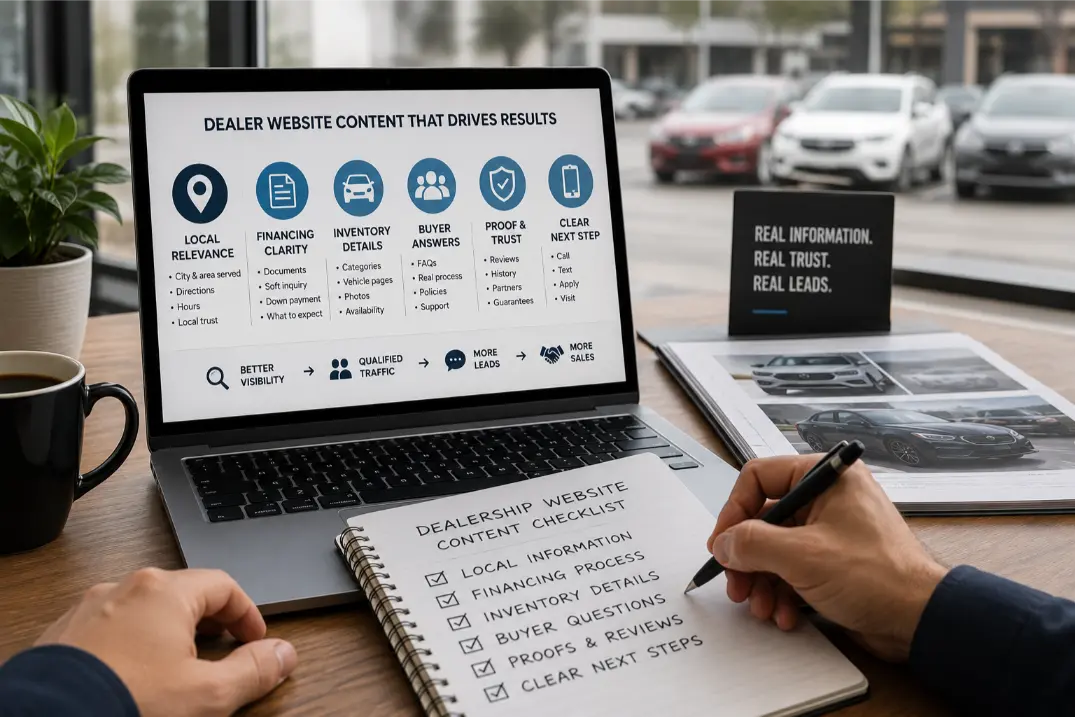
A strong dealership page should explain who the business serves, where it operates, what buyers can expect, which services are actually available, and how the next step works. The copy should help a shopper make a decision that could not be made from a competitor’s template.
Replace Broad Claims With Specific Local Details
Local details make copy more useful because they connect the dealership to a real market. Useful information may include the primary city, surrounding communities served, nearby routes or landmarks, the physical location, business hours, local phone number, delivery or pickup practices, and the types of buyers commonly assisted.
The goal is not to repeat the city name in every paragraph. The goal is to show how the dealership operates in that market. A page that explains how buyers from surrounding communities reach the store, which documentation they should bring, and how inventory or financing conversations begin provides more value than a paragraph that simply says the dealership is “proud to serve the area.”
Explain the Real Financing Process
BHPH and finance-first shoppers often visit a website with practical questions: What documents are required? Can self-employed buyers apply? Does the initial form involve a soft or hard inquiry? How is the down payment determined? What happens after submitting the form?
Generic copy often avoids these questions and substitutes reassurance such as “fast and easy approval.” Better copy explains the process without making promises the dealership cannot support. It distinguishes an initial inquiry from final approval, identifies which details may vary, and tells the shopper what to prepare.
Use Inventory Information as Content, Not Just a Feed
A dealership website should not treat inventory as a disconnected software module. The surrounding copy can explain the vehicle categories the dealership commonly stocks, how shoppers can filter options, what happens when a listed vehicle sells, and how buyers can ask about alternatives.
Vehicle detail pages should include accurate specifications, original photos when possible, condition disclosures, price or inquiry guidance, financing paths, and dealership-specific calls to action. Reused descriptions that list features without context do little to distinguish the vehicle or the seller.
Answer the Buyer Questions Staff Hear Every Week
One of the best sources of useful website copy is the dealership’s own phone calls, text messages, form submissions, and showroom conversations. Repeated questions reveal what buyers need before they are ready to act.
Examples include required documents, trade-in equity, payment frequency, insurance needs, warranty eligibility, service options, credit reporting, online applications, first-time buying, self-employed income, and how long a typical visit may take. Each answer should reflect the dealership’s real process rather than a generic industry assumption.
Show Proof Instead of Repeating Superlatives
Statements such as “best dealer,” “number one,” “largest selection,” or “guaranteed approval” create risk when they are not supported. Proof is more persuasive than adjectives.
Useful proof can include current inventory, named service capabilities, documented financing requirements, platform-specific reviews, verified business history, staff expertise, approved partner relationships, vehicle-specific history reports, and clear warranty or service-contract terms. Every proof point should be attributable and kept current.
Make the About Page Operationally Useful
Many dealership About pages contain a short paragraph about honesty and customer service. A stronger page explains the dealership’s history, ownership or brand relationship, location, audience, financing approach, inventory focus, and the practical values that shape the customer experience.
It should also clarify legal and consumer-facing names when they differ. This supports trust, entity consistency, local SEO, and AI systems that try to understand which website belongs to which real-world business.
Create Distinct Pages for Distinct Search Intent
Trying to make one homepage rank for every city, vehicle type, financing question, and customer situation usually produces vague copy. Stronger sites separate important intents into useful pages.
- Homepage for the dealership’s primary identity, market, services, and conversion paths.
- Location page for address, hours, map, directions, phone, and communities served.
- Financing page for process, documentation, eligibility context, and next steps.
- Inventory hub and vehicle detail pages for current shopping intent.
- About and trust pages for history, people, proof, policies, and brand relationships.
- FAQ and educational pages for real buyer concerns.
- City pages only when the dealership can provide meaningful local information.
Internal Links Should Guide the Shopper
Useful copy connects information with the next logical action. An article about financing documentation should link to the application path. A city page should link to the true location, relevant inventory, and financing information. A vehicle page should help the shopper understand the dealership and contact options.
Turbo Dealer Websites combines automotive website design, SEO, inventory tools, and conversion features for independent dealers. Operators evaluating the overall platform can review the Turbo Dealer Websites platform.
Collect Dealership-Specific Information Before Writing
Good copy requires good inputs. Before writing or rebuilding a website, collect the approved dealership name, legal entity, address, phone, hours, markets served, inventory process, financing options, required documents, trade-ins, service capabilities, warranties, payment methods, credit inquiry language, bilingual support, review sources, and prohibited claims.
Turbo Dealer’s dealer website onboarding process shows the level of operational detail needed to create localized, dealership-specific website content.
Audit Every Template Before Launch
Templates can accelerate production, but they also create duplication and brand errors. Audit every page for another dealer’s name, old phone numbers, incorrect cities, off-brand privacy language, outdated forms, unsupported claims, duplicate title tags, and placeholder content.
The audit should include headers, footers, metadata, structured data, image alt text, form confirmations, consent language, policies, inventory pages, and staging domains. One copied business name in a finance form can undermine trust more quickly than several well-written paragraphs can build it.
Measure Copy by Qualified Actions
Traffic alone does not prove that dealership copy is working. Review which pages generate calls, applications, inventory inquiries, directions, trade-in requests, and engaged visits. Search Console data can show the queries and pages creating impressions, while analytics and CRM data can help connect content with lead quality.
Weak pages should be improved using real questions and dealership facts rather than expanded with filler. A shorter page that answers the correct concern can outperform a longer page filled with generic claims.
How Turbo Dealer Supports More Specific Dealer Content
Turbo Dealer Websites provides independent retail and BHPH dealers with mobile-first websites, dealership-focused SEO, smart lead forms, inventory tools, keyword tracking, analytics, and ongoing support. The onboarding process gathers dealership-specific operational details so the site can reflect the actual business rather than relying only on automotive templates.
After launch, dealers can use Turbo Dealer’s website support resources for content, configuration, and inventory-related updates.
No website provider can responsibly guarantee rankings, leads, or sales. The practical advantage of specific copy is that it gives shoppers and search systems clearer reasons to understand, trust, and choose the dealership.
Frequently Asked Questions
Why does generic dealer website copy perform poorly?
It provides little unique information about the dealership, market, services, process, proof, or buyer experience. That makes the page less useful to shoppers and less distinctive in search.
Should dealership copy include local keywords?
Yes, when they fit naturally and accurately. Local details should explain the dealership’s real location and service area rather than repeating city names without useful context.
What should a BHPH financing page explain?
It should explain the application process, documents that may be requested, what happens next, which terms vary, and any approved disclosures about credit inquiries, down payments, or payment schedules.
How can a dealer make website copy more original?
Use real dealership facts, staff knowledge, buyer questions, inventory practices, financing procedures, local details, and verifiable proof. Remove language that could be pasted onto a competitor’s website unchanged.
Does longer dealership copy rank better?
Not automatically. Length is useful only when the page answers more relevant questions with accurate, original information. Filler can make the page harder to use without improving search value.
RELATED LINK: Google Search Central – Creating Helpful, Reliable, People-First Content